
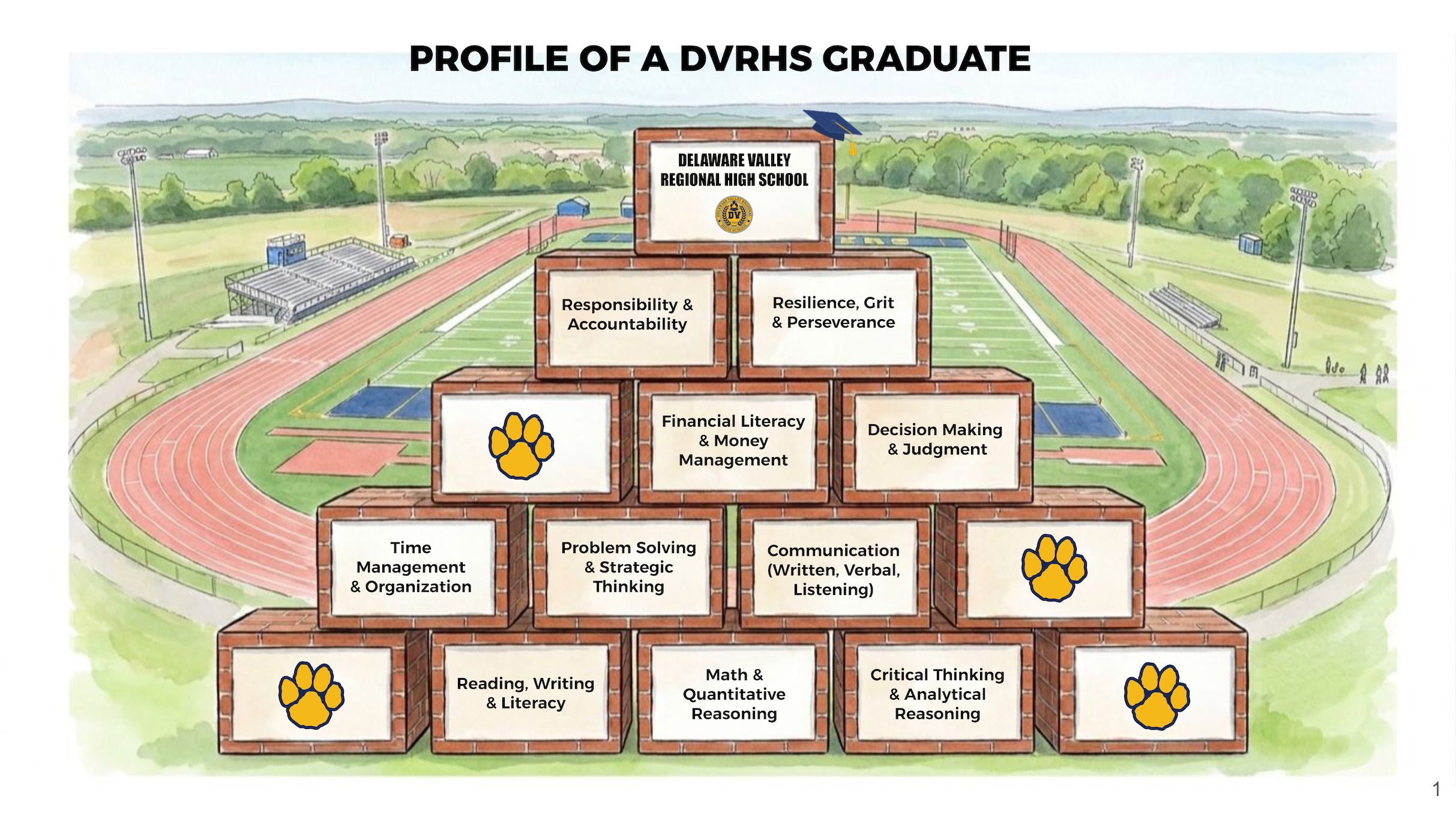
Profile of a DVRHS Graduate
Academic Knowledge and Skills
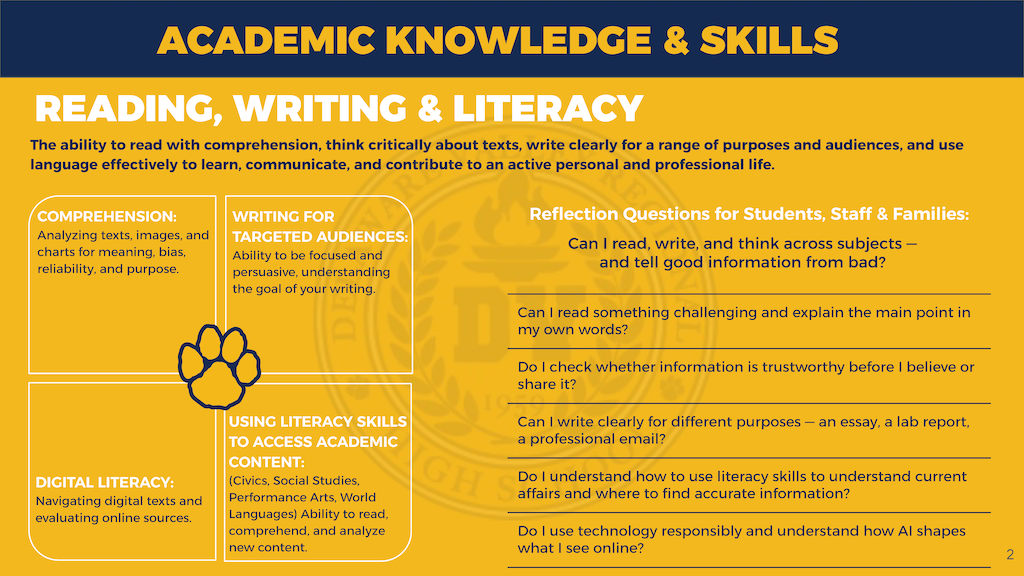
Reading, Writing, and Literacy
The ability to read with comprehension, think critically about texts, write clearly for a range of purposes and audiences, and use language effectively to learn, communicate, and contribute to an active personal and professional life.
Comprehension: Analyzing texts for meaning, bias, reliability, and purpose
Writing for targeted audiences: Ability to be focused and persuasive, understanding the goal of your writing
Digital Literacy: Navigating digital texts and evaluating online sources
Using literacy skills to access academic content (Civics, Social Studies, Performance Arts, World Languages): Ability to read, comprehend, and analyze new content
Reflection Questions for Students, Staff, & Families
Can I read, write, and think across subjects — and tell good information from bad?
Can I read something challenging and explain the main point in my own words?
Do I check whether information is trustworthy before I believe or share it?
Can I write clearly for different purposes — an essay, a lab report, a professional email?
Do I understand how our government works and what's happening in the world?
Do I use technology responsibly and understand how AI shapes what I see online?
Cognitive Skills
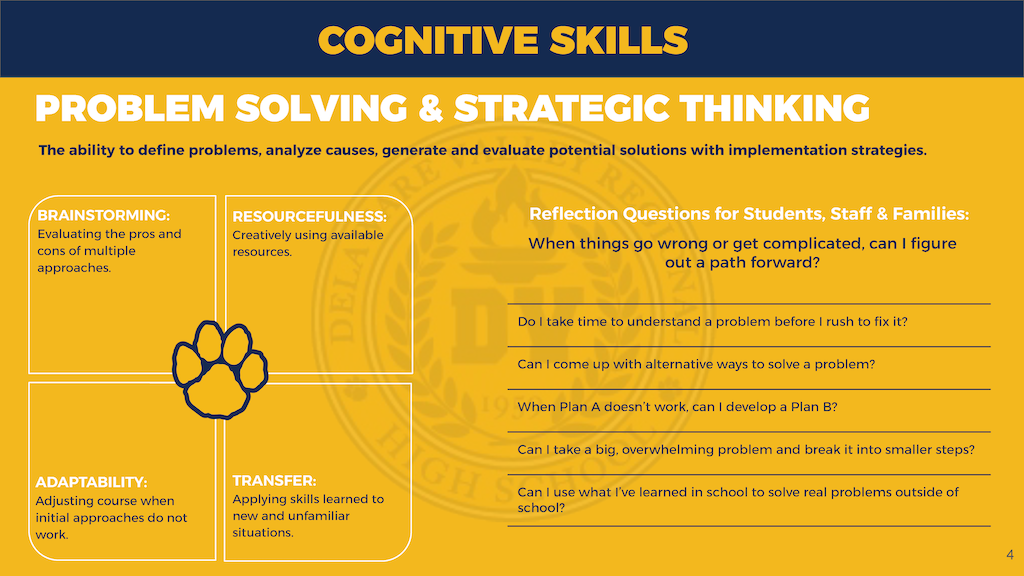
Problem Solving and Strategic Thinking
The ability to define problems, analyze causes, and generate and evaluate potential solutions with implementation strategies.
Brainstorming: Evaluating the pros and cons of multiple approaches
Resourcefulness: Creatively using available resources
Adaptability: Adjusting course when initial approaches do not work
Transfer: Applying skills learned to new and unfamiliar situations
Reflection Questions for Students, Staff, & Families
When things go wrong or get complicated, can I figure out a path forward?
Do I take time to understand a problem before I rush to fix it?
Can I come up with more than one way to solve a problem?
When Plan A doesn't work, can I develop a Plan B?
Can I take a big, overwhelming problem and break it into smaller steps?
Can I use what I've learned in school to solve real problems outside of school?
Cognitive Skills
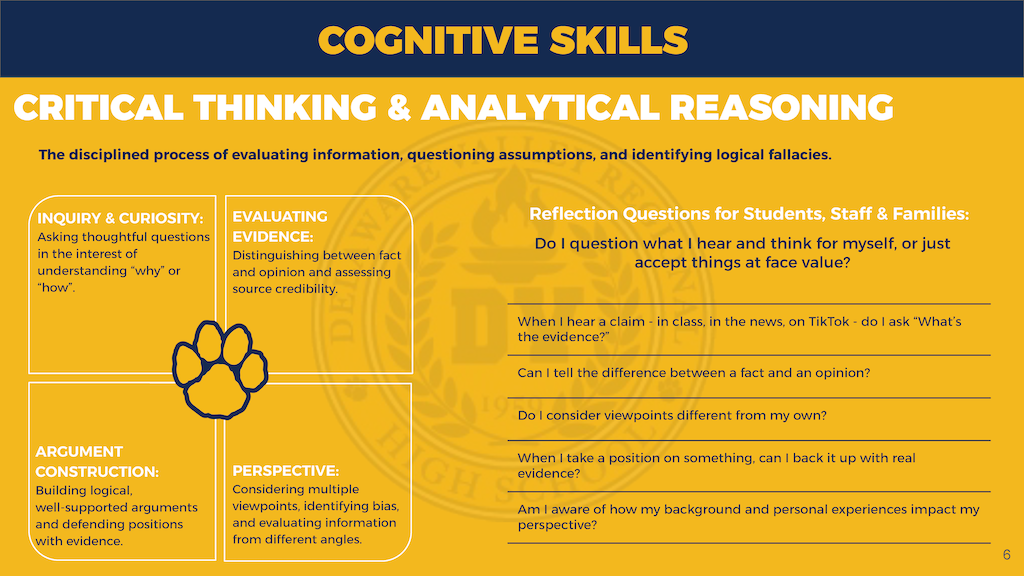
Critical Thinking and Analytical Reasoning
The disciplined process of evaluating information, questioning assumptions, and identifying logical fallacies.
Inquiry and Curiosity: Asking thoughtful questions in the interest of understanding ‘why’ or ‘how’
Evaluating Evidence: Distinguishing between fact and opinion and assessing source credibility
Argument Construction: Building logical, well-supported arguments and defending positions with evidence
Perspective: Considering multiple viewpoints, identifying bias, and evaluating information from different angles
Reflection Questions for Students, Staff, & Families
Do I question what I hear and think for myself, or just accept things at face value?
When I hear a claim — in class, in the news, on TikTok — do I ask 'What's the evidence?'
Can I tell the difference between a fact and an opinion?
Do I consider viewpoints different from my own?
When I take a position on something, can I back it up with real evidence?
Am I aware of how my background and personal experiences impact my perspective?
Character and Collaboration
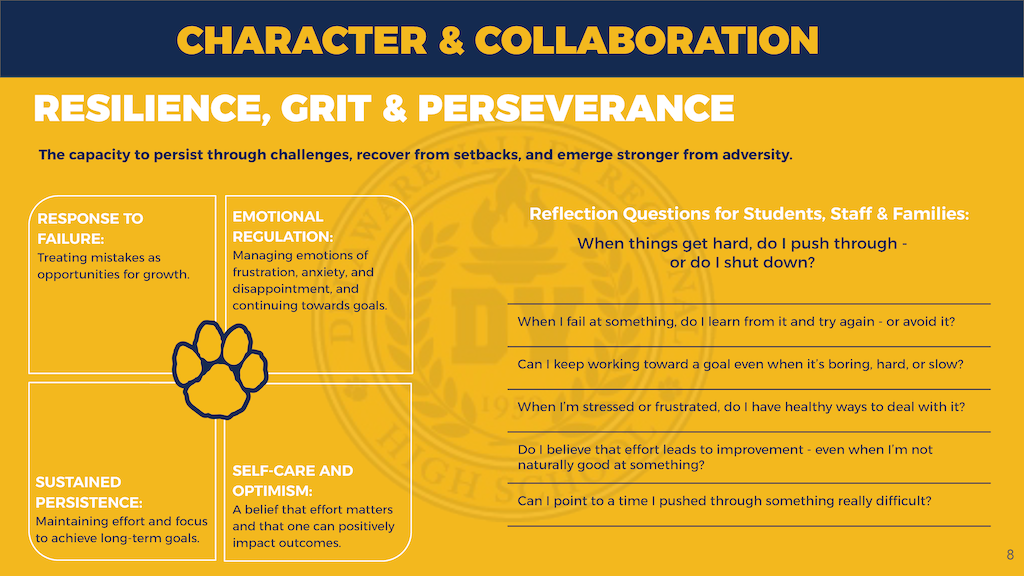
Resilience, Grit, and Perseverance
The capacity to persist through challenges, recover from setbacks, and emerge stronger from adversity.
Response to failure: Treating mistakes as opportunities for growth
Emotional regulation: Managing emotions of frustration, anxiety, and disappointment, and continuing towards goals
Sustained Persistence: Maintaining effort and focus to achieve long-term goals
Self-Care and Optimism: A belief that effort matters and that one can positively impact outcomes
Reflection Questions for Students, Staff, & Families
When things get hard, do I push through — or do I shut down?
When I fail at something, do I learn from it and try again — or avoid it?
Can I keep working toward a goal even when it's boring, hard, or slow?
When I'm stressed or frustrated, do I have healthy ways to deal with it?
Do I believe that effort leads to improvement — even when I'm not naturally good at something?
Can I point to a time I pushed through something really difficult and came out better?
Practical Competencies
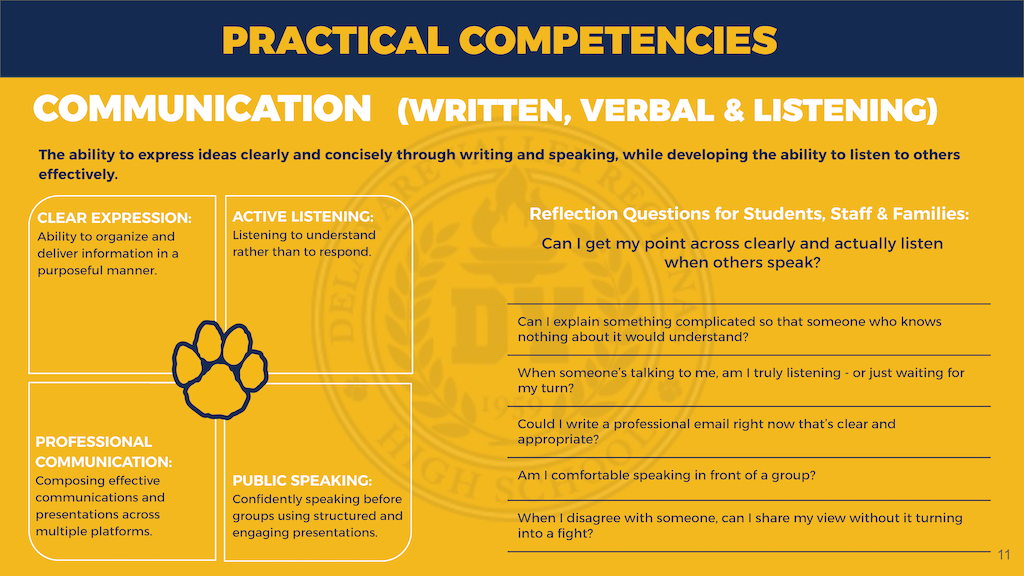
Communication (Written, Verbal, and Listening)
The ability to express ideas clearly and concisely through writing and speaking, while developing the ability to listen to others effectively.
Clear Expression: Ability to organize and deliver information in a purposeful manner
Active Listening: Listening to understand rather than to respond
Professional Communication: Composing effective communications and presentations across multiple platforms
Public Speaking: Confidently speaking before groups using structured and engaging presentations
Reflection Questions for Students, Staff, & Families
Can I get my point across clearly and actually listen when others speak?
Can I explain something complicated so that someone who knows nothing about it would understand?
When someone's talking to me, am I truly listening — or just waiting for my turn?
Could I write a professional email right now that's clear and appropriate?
Am I comfortable speaking in front of a group?
When I disagree with someone, can I share my view without it turning into a fight?
Academic Knowledge and Skills
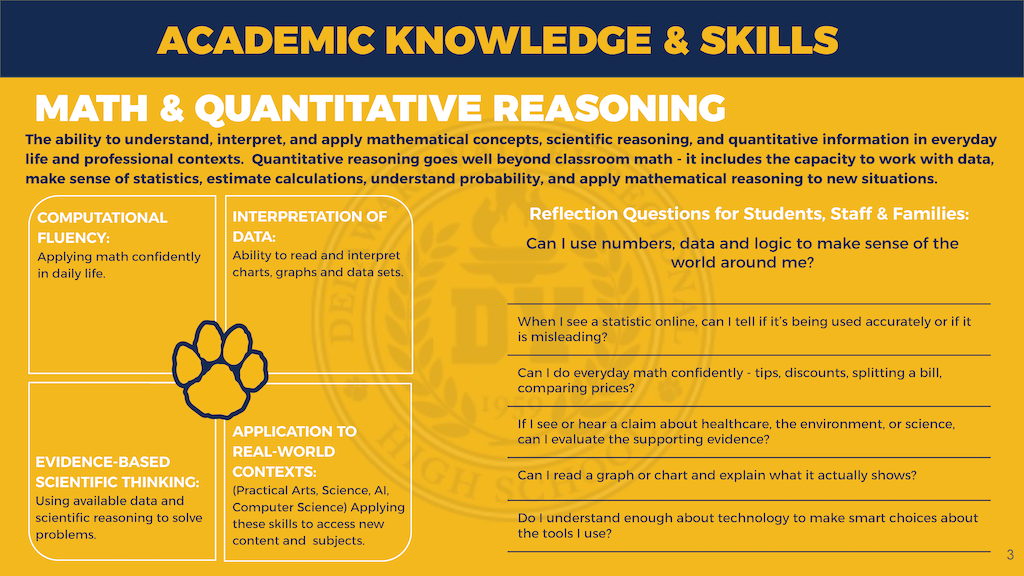
Math and Quantitative Reasoning
The ability to understand, interpret, and apply mathematical concepts, scientific reasoning, and quantitative information in everyday life and professional contexts. Quantitative reasoning goes well beyond classroom math — it includes the capacity to work with data, make sense of statistics, estimate calculations, understand probability, and apply mathematical reasoning to new situations.
Computational Fluency: Applying math confidently in daily life
Interpretation of Data: Ability to read and interpret charts, graphs, and data sets
Evidence-Based Scientific Thinking: Using available data and scientific reasoning to solve problems
Application to real-world contexts (Practical Arts, Science, AI, Computer Science): Applying these skills to access new content and subjects
Reflection Questions for Students, Staff, & Families
Can I use numbers, data, and logic to make sense of the world around me?
When I see a statistic online, can I tell if it's being used fairly or if it's misleading?
Can I do everyday math confidently — tips, discounts, splitting a bill, comparing prices?
If I see or hear a claim about healthcare, the environment, or science, can I evaluate the supporting evidence?
Can I read a graph or chart and explain what it actually shows?
Do I understand enough about technology to make smart choices about the tools I use?
Cognitive Skills
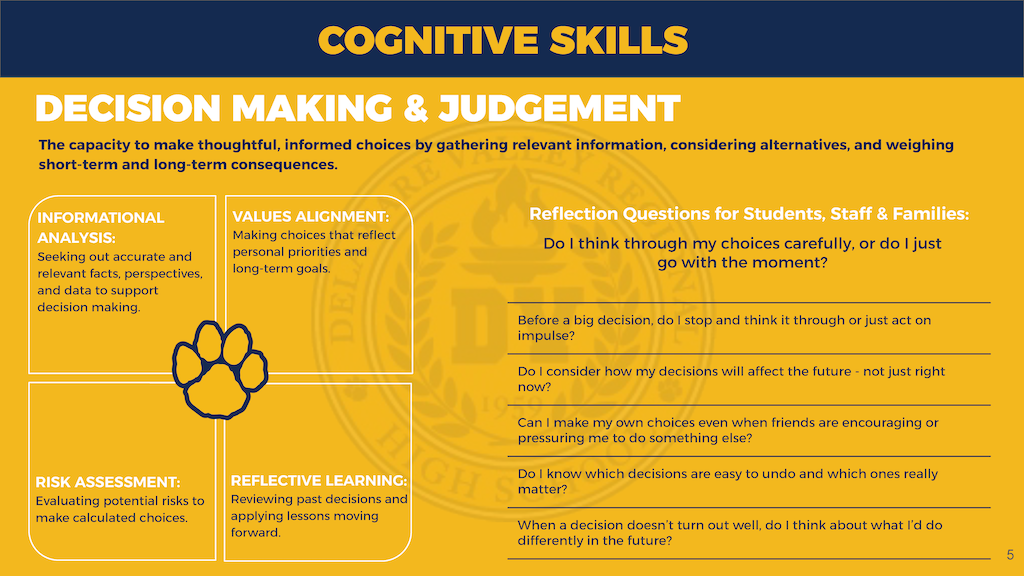
Decision-Making and Judgement
The capacity to make thoughtful, informed choices by gathering relevant information, considering alternatives, and weighing short-term and long-term consequences
Informational Analysis: Seeking out accurate and relevant facts, perspectives, and data to support decision-making
Values Alignment: Making choices that reflect personal priorities and long-term goals
Risk Assessment: Evaluating potential risks to make calculated choices
Reflective Learning: Reviewing past decisions and applying lessons moving forward
Reflection Questions for Students, Staff, & Families
Do I think through my choices carefully, or do I just go with the moment?
Before a big decision, do I stop to think it through or just act on impulse?
Do I consider how my decisions will affect the future — not just right now?
Can I make my own choices even when friends are encouraging or pressuring me to do something else?
Do I know which decisions are easy to undo and which ones really matter?
When a decision doesn't turn out well, do I think about what I'd do differently in the future?
Character and Collaboration
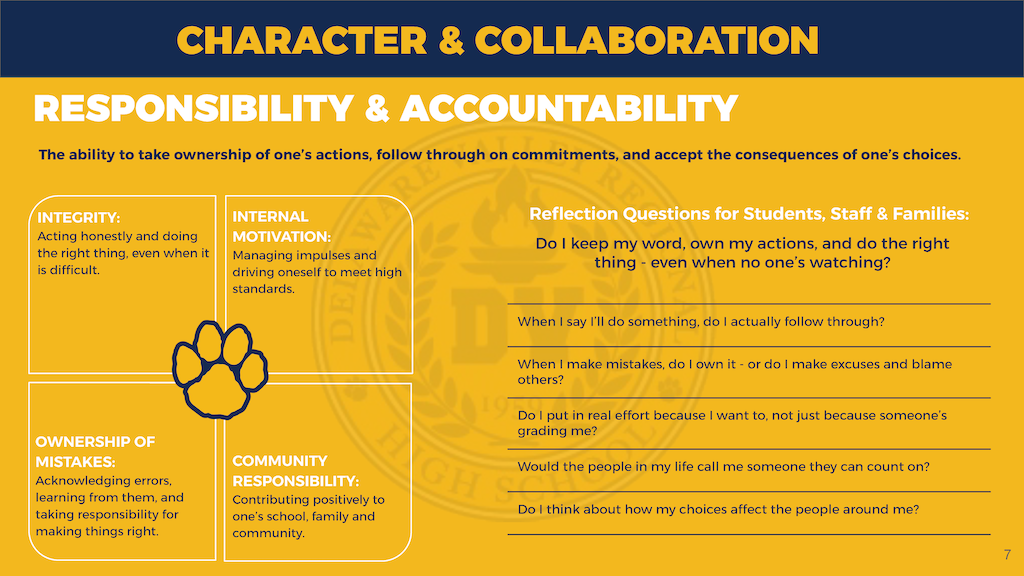
Responsibility and Accountability
The ability to take ownership of one’s actions, follow through on commitments, and accept the consequences of one’s choices.
Integrity: Acting honestly and doing the right thing, even when it is difficult
Internal Motivation: Managing impulses and driving oneself to meet high standards
Ownership of Mistakes: Acknowledging errors, learning from them, and taking responsibility for making things right
Community Responsibility: Contributing positively to one’s school, family, and community
Reflection Questions for Students, Staff, & Families
Do I keep my word, own my actions, and do the right thing — even when no one's watching?
When I say I'll do something, do I actually follow through?
When I make mistakes, do I own it — or do I make excuses and blame others?
Do I put in real effort because I want to, not just because someone's grading me?
Would the people in my life call me someone they can count on?
Do I think about how my choices affect the people around me?
Practical Competencies
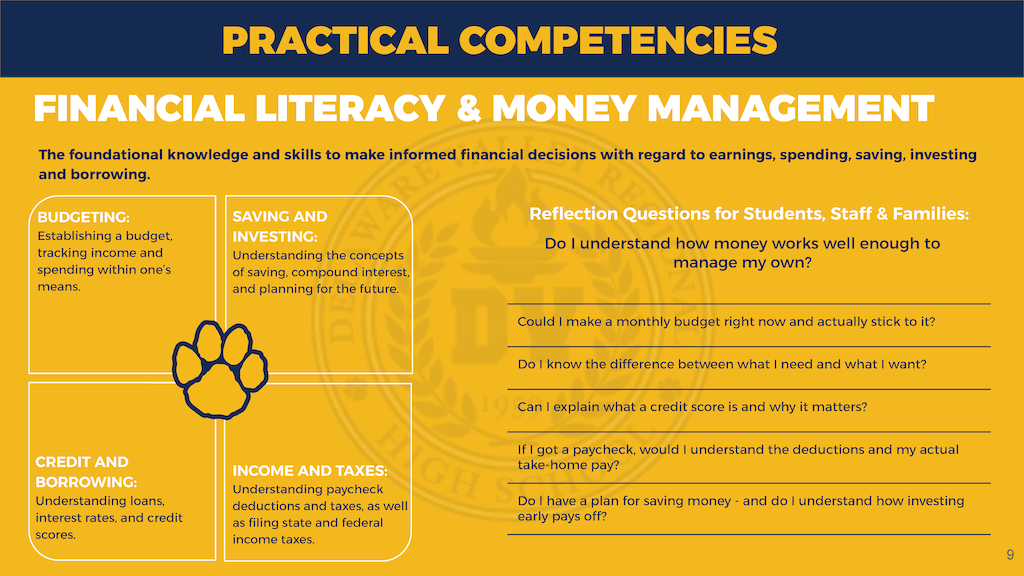
Financial Literacy and Money Management
The foundational knowledge and skills to make informed financial decisions with regard to earnings, spending, saving, investing, and borrowing.
Budgeting: Establishing a budget, tracking income and spending within one’s means
Saving and Investing: Understanding the concepts of saving, compound interest, and planning for the future
Credit and Borrowing: Understanding loans, interest rates, and credit scores
Income and Taxes: Understanding paycheck deductions and taxes, as well as filing state and federal income taxes
Reflection Questions for Students, Staff, & Families
Do I understand how money works well enough to manage my own?
Could I make a monthly budget right now and actually stick to it?
Do I know the difference between what I need and what I want?
Can I explain what a credit score is and why it matters?
If I got a paycheck, would I understand the deductions and my actual take-home pay?
Do I have a plan for saving money — and do I understand how investing early pays off?
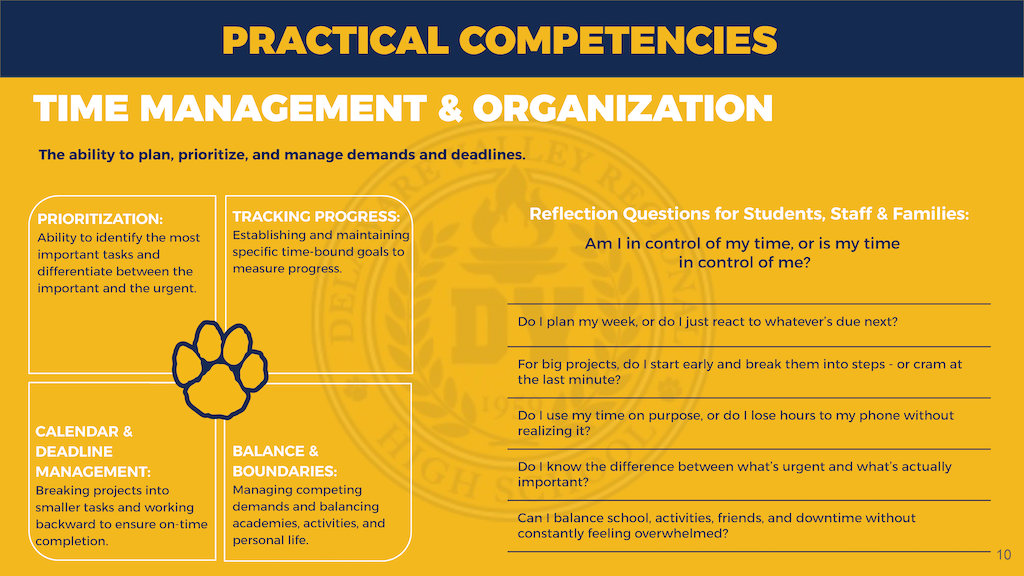
Practical Competencies
Time Management and Organization
The ability to plan, prioritize, and manage demands and deadlines.
Prioritization: Ability to identify the most important tasks and differentiate between the important and the urgent
Tracking Progress: Establishing and maintaining specific, time-bound goals to measure progress
Calendar and Deadline Management: Breaking projects into smaller tasks and working backward to ensure on-time completion
Balance and Boundaries: Managing competing demands and balancing academics, activities, and personal life
Reflection Questions for Students, Staff, & Families
Am I in control of my time, or is my time in control of me?
Do I plan my week, or do I just react to whatever's due next?
For big projects, do I start early and break them into steps — or cram at the last minute?
Do I use my time on purpose, or do I lose hours to my phone without realizing it?
Do I know the difference between what's urgent and what's actually important?
Can I balance school, activities, friends, and downtime without constantly feeling overwhelmed?